Today, Tues. 7/28, is the first full day of Pacific Yearly Meeting's annual session.
Last night, presiding clerk Joe Franko welcomed us (if I had more time I'd link to his blog). He said PacYM was even more like Brigadoon that evening, because the fog was in, we were meeting in a tent not a building, and a Friend was practicing his bagpipes in the distance.
Joe said we are here as a community of faith. Yet the Spirit blows where it will. Friends need to present their ideas or proposals, then step back and make space for the Spirit to enter. We don't have a product to create or a goal. We have a process we know works, our Quaker process, and we need to give it space to work.
The plenary to discuss creation of a youth coordinator position -- which would be the yearly meeting's sole staffer -- is supposed to start in 25 minutes. I skipped the first hour of regular business, I'm afraid. (I had an urgent work matter I'm monitoring, so, here I am....)
For the first time in several years I'm neither on the Children's Program Committee nor a teacher. Nonetheless, I ended up volunteering for the first part of the morning with the elementary group. It was fun, and I think Seven Year Old was happy to have me there, without being particularly attached. Then I went to worship sharing, where the community was, "What does community mean to me?"
I'm here without Robin until the end of the week, so I'm parenting solo. Fortunately, our boys are old enough, and experienced enough with yearly meeting, to hang out with their friends with much looser boundaries, and our various families hang out together, too. It reminds me of something Bill McKibben wrote in Deep Economy, about the way humans are supposed to live in community.
I brought my camera but not the cord to connect it to the computer, so I can't upload the photos from last night of Joe Franko, and of the boys on top of a big rock. Walker Creek Ranch is beautiful.


7/24/2009
A vision for an anti-war coffeehouse event
A lot of pro-peace people say, "It's not enough to be against war, you also have to be for peace."
While I agree with that, I can't help but think: "It's not enough to be pro-peace, you also have to be against war."
Simplistic, but true. What have I done lately to make the world a safer place? Not much.
I had a vision of organizing a Friday or Saturday evening anti-war coffeehouse at the Quaker meetinghouse, with open mic and open wifi. You could versify, sing, or chant. You could have conversations about the issues. You could weep and moan if you needed, or laugh and dance if you were moved to.
You could email your friends to explain your views. You could write letters to your Representative and Senator. You could write letters to the editors of the local papers, which is arguably more effective because it's more public. (And "papers" is plural because the SF Bay Area still has several papers for now, including many freebies.)
If you're originally from somewhere else in the country or world, you could write to your hometown paper and express your views.
(Even if you're not a pacifist, you could come if you're against the current wars in Iraq and Afghanistan.)
And you could feel less alone and more engaged. I'd like that part.
While I agree with that, I can't help but think: "It's not enough to be pro-peace, you also have to be against war."
Simplistic, but true. What have I done lately to make the world a safer place? Not much.
I had a vision of organizing a Friday or Saturday evening anti-war coffeehouse at the Quaker meetinghouse, with open mic and open wifi. You could versify, sing, or chant. You could have conversations about the issues. You could weep and moan if you needed, or laugh and dance if you were moved to.
You could email your friends to explain your views. You could write letters to your Representative and Senator. You could write letters to the editors of the local papers, which is arguably more effective because it's more public. (And "papers" is plural because the SF Bay Area still has several papers for now, including many freebies.)
If you're originally from somewhere else in the country or world, you could write to your hometown paper and express your views.
(Even if you're not a pacifist, you could come if you're against the current wars in Iraq and Afghanistan.)
And you could feel less alone and more engaged. I'd like that part.
7/16/2009
Vanessa Julye to speak at SF Friends Meeting
You're invited to hear Vanessa Julye, author of the new book Fit for Freedom, Not for Friendship: Quakers, African Americans, and the Myth of Racial Justice, co-authored by Donna McDaniel, at San Francisco Friends Meeting on Sunday, August 2nd. The meeting is in S.F. at 65 9th Street, between Mission & Market, near the Civic Center BART station.
Vanessa will discuss the book and sign copies. We expect to start around 12:45 or 1:00 pm. (Please join us for worship at 11 am and our monthly potluck at 12:15 if you can!) Vanessa is the program coordinator for the committee for ministry on racism of Friends General Conference. Vanessa will also be attending Pacific Yearly Meeting sessions at the end of July.
If you're interested in purchasing a book or the study guide, let me know. (Cover price is $28.) We will probably pre-order some copies to have on hand for the signing.
You can also order your own copy from Quaker Books of FGC.
Vanessa will discuss the book and sign copies. We expect to start around 12:45 or 1:00 pm. (Please join us for worship at 11 am and our monthly potluck at 12:15 if you can!) Vanessa is the program coordinator for the committee for ministry on racism of Friends General Conference. Vanessa will also be attending Pacific Yearly Meeting sessions at the end of July.
If you're interested in purchasing a book or the study guide, let me know. (Cover price is $28.) We will probably pre-order some copies to have on hand for the signing.
You can also order your own copy from Quaker Books of FGC.
7/12/2009
Two Gems from Quaker Business Meeting
Today at San Francisco Monthly Meeting, the following two gems were offered, and I wanted to capture them here.
The first person said his two communities in San Francisco are the Friends meeting and the S.F. Gay/Lesbian Freedom Band (they do the "Dance-Along Nutcracker" every December). He compared making music with the band to a Friends meeting:
The first person said his two communities in San Francisco are the Friends meeting and the S.F. Gay/Lesbian Freedom Band (they do the "Dance-Along Nutcracker" every December). He compared making music with the band to a Friends meeting:
Silence is our canvas. We seek harmony. Dissonance is not always a bad thing. And when the dissonance resolves into harmony, it makes the harmony that much sweeter.The second person described the possibility of some renovations in our building, the extent of which we don't have unity on yet:
I hope we'll do the things we need to do and not do the things we don't need to do.I thought that was a really good guide, actually—a reminder that we shouldn't do something just because we can or because "everyone" does, but only because it's needed and we hear the call of the Spirit to do it.
6/18/2009
Bill McKibben's Deep Economy
I read Bill McKibben's Deep Economy several weeks ago with great enjoyment and renewed sense of optimism about the future.
I liked the book because he presented many examples of communities that are doing real things to make changes in the way they live, farm, eat, or build community, so that they can help sustain the earth and the ecosphere. He also had some great data about trends, such as the explosive growth in farmers' markets over the last 20 years, and the productivity of small, intensively farmed agricultural land compared to huge tracts of industrially farmed land. And in places his analysis seems so obvious, I wondered why I hadn't thought of it before; such as the decline in number of U.S. farmers is because they have been replaced with machines running on (heretofore) cheap oil.
Here are some passages I found interesting:
McKibben highlights three challenges to growth:
Striking language on page 17:
PS A final Quaker note: There's a nice quote from Quaker economist Kenneth Boulding on page 24.
I liked the book because he presented many examples of communities that are doing real things to make changes in the way they live, farm, eat, or build community, so that they can help sustain the earth and the ecosphere. He also had some great data about trends, such as the explosive growth in farmers' markets over the last 20 years, and the productivity of small, intensively farmed agricultural land compared to huge tracts of industrially farmed land. And in places his analysis seems so obvious, I wondered why I hadn't thought of it before; such as the decline in number of U.S. farmers is because they have been replaced with machines running on (heretofore) cheap oil.
Here are some passages I found interesting:
Page 2: Shifting our focus to local economies will not mean abandoning Adam Smith or doing away with markets. Markets, obviously, work. Building a local economy will mean, however, ceasing to worship markets as infallible and consciously setting limits on their scope. We will need to downplay efficiency and pay attention to other goals. We will have to make the biggest changes to our daily habits in generations—and the biggest change, as well, to our worldview, our sense of what constitutes progress.Concluding his introduction, McKibben mentions a trip to China, where he met a 12-year-old girl named Zhao Lin Tao, who lives in a poor rural village: “about the most statistically average person on earth.” She was proud of her English; yet her mother left the family to work in a factory, and Zhao has a hard life. "In Zhao’s world, in other words, it’s perfectly plausible that More and Better still share a nest. Any solution we consider has to contain some answer for her tears. Her story hovers over this whole enterprise. She’s a potent reality check."
… The key questions will change from whether the economy produces an ever larger pile of stuff to whether it builds or undermines community—for community, it turns out, is the key to physical survival in our environmental predicament and also to human satisfaction. Our exaltation of the individual, which was the key to More [as in, the pursuit of More More More], has passed the point of diminishing returns. It now masks a deeper economy that we should no longer ignore.
[Like “deep ecology,”] we need a similar shift in our thinking about economics—we need it to take human satisfaction and society durability more seriously; we need economics to mature as a discipline.
McKibben highlights three challenges to growth:
- Politically, growth is distributed unequally.
- We don't have the energy needed to keep growth going as it has done.
- The third argument is both less obvious and even more basic: growth is no longer making us happy. [his emphasis]
Striking language on page 17:
If fossil fuel is a slave at our beck and call, renewable power is more like a partner…. It seems likely that fossil fuel was an exception to the rule, a onetime gift that underwrote a onetime binge of growth. In any event, we seem to be on track to find out.As mentioned he says that small farms are more productive, and large farms are built on cheap energy:
Page 64: Because of its reliance on cheap energy, the efficiency of our vast farms and the food system they underwrite is in one sense an illusion, and perhaps a very temporary one. The number of American farmers has fallen from half the American population to about 1 percent, and in essence those missing farmers have been replaced with oil. We might see fossil fuel as playing the same role that slaves played in early American agriculture—a “natural resource” that comes cheap…. There aren’t many people on that farm, but there’s all kinds of machinery, and every bit of it is burning fuel. Here’s the math: between 1910 and 1983, U.S. corn yields grew 346 percent. Energy consumption for agriculture increased 810 percent. [my emphasis]The section on page 108 on the "declining marginal returns" of both income and companionship are really worth reading, so I won't quote it here. He continues:
Every measure of psychological health points to the same conclusion: people who “are married, who have good friends, and who are close to their families are happier than those who are not,” says the Swarthmore psychologist Barry Schwartz. “People who participate in religious communities are happier than those who are not.” Which is striking, Schwartz adds, because social ties “actually decrease freedom of choice.” To be a good friend is hard work.So, f/Friends, take heart!
PS A final Quaker note: There's a nice quote from Quaker economist Kenneth Boulding on page 24.
Busy Season
I haven't had a chance to post much lately. It's been a mite busy around here. There was Affordable Housing Week in May as well as some staff transitions and budget issues at work, plus Quarterly Meeting and our monthly meeting's retreat also in May, and then the end of the school year came this month with presentation night and portfolio day and school plays, on Tuesday the big end-of-school meeting for worship and celebration in Golden Gate Park, sleepaway Quaker camp at Ben Lomond Quaker Center for 11 Year Old this week, and no camp for Seven Year Old this week. Whew!)
Anyway, I read a great book several weeks ago, and today I had a chance to capture the good bits, which I'll post separately.
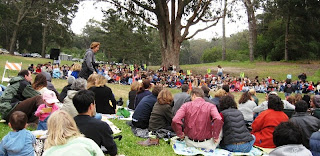
Here's a photo immediately after the end of the all-school meeting for worship, 6/16/2009:
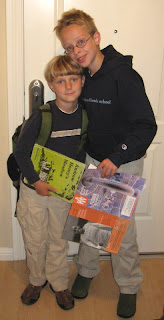
Here's a photo of the boys before they left for the last day of school:
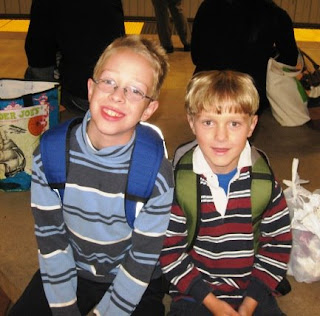
 And for comparison, this is what they looked like on the first day of school in September 2008:
Anyway, I read a great book several weeks ago, and today I had a chance to capture the good bits, which I'll post separately.
Here's a photo immediately after the end of the all-school meeting for worship, 6/16/2009:

Here's a photo of the boys before they left for the last day of school:
 And for comparison, this is what they looked like on the first day of school in September 2008:
Subscribe to:
Posts (Atom)
