11/09/2006

So you want to be a Quaker!

[First draft text of a brochure that an unprogramed meeting could publish about joining! Inspired by a new attender at our meeting.]

You have attended Friends meeting for a time and now you would like to know about becoming a member. Great! It sounds like you are ready.

So now you might ask yourself if you are prepared.

Here are some suggestions for further reflection and action on the path toward joining our meeting:
  • Read the section about membership in Faith and Practice of Pacific Yearly Meeting. Better yet, try to browse through the whole book. It has advices and queries for individual and corporate reflection, as well as practical information about things like membership, marriage, memorials, what Quakers believe. It's sort of a User's Manual for Quakers.

  • Begin attending monthly meeting for business. The Quaker process of seeking unity with God's will in our decision making is one of the core practices of Friends. It is worth experiencing it just as you experience our weekly meeting for worship.

  • Read some more about Quaker history, or better yet, ask one of the longtime members of our meeting to tell you more.

  • Spend some time in personal reflection and prayer. Is this the right community and faith tradition for you?

  • You might want to read through the monthly magazines Friends Journal and Friends Bulletin for topics that are current among Friends. Both are available in our library. Similarly, a number of Quaker websites and blogs contain interesting information and discussions.

  • Above all, remember that we are human! You will encounter discomfort, mistakes, and pain here just as you would in any human community. With any luck, we will all remember to act out of love and support when we hit the rough patches. And sometimes we won't, and that will hurt. Yet with grace, we will have the strength and courage to admit our failings to one another and step into forgiveness together. It takes work to forge community, especially in this consumer culture where everything seems to be disposable, including relationship. Community takes time. It's an investment.

  • When you're prepared, you can write a letter asking to become a member. It can be one sentence, or it can be two or three pages about your spiritual journey. Be aware that it will be read out loud in the meeting for business. Then the ministry and oversight committee will appoint a clearness committee to meet with you, learn more about what brought you to us, give us a chance to share some of our own experience, and provide clearness about your membership application itself.
That's about it. We're here if you have any questions. Just let us know. Thanks for asking!
- - - - - -

Does your meeting have anything like this? I've seen some of the pamphlets from Northwest Yearly Meeting; it's no surprise that evangelical Friends are better at this than unprogrammed Frieds. I'd sure like our meeting to have something besides a response such as, "Well, stick around a few years and you'll know"! I don't know that's the kind of thing people at my current meeting say, but that's the general sense I have had at meetings I've attended. What's your experience?

11/06/2006

Hardhats on! We're building community!

Saturday night, I finally got to catch up on some blog reading (Robin M. was elsewhere), including the post over at Nancy's Apology on the November blahs. She wrote:

American author Annie Dillard says if we had any real faith, we'd wear hardhats to church/meeting—after all, we are calling on or getting in touch with the very forces of the universe. The universe might come crashing down on our heads.


The next day, Sunday morning, it was my turn to teach Firstday School. So I brought our two hardhats, one child-sized and one grownup-sized, and scooped up the one from the meeting's nursery, and put together a loose lesson....

We started with some check-in time. The four children, from 8 to 14 years old, of course wanted to know why the hardhats were on the table. I explained about the Dillard quote, and you never know when something might come crashing down.

I suggested that some Bible stories were like that—the Tower of Babel for example. One participant retold us that story. Henry said, "Or like the walls of Jericho." He was struggling to remember just exactly had happened to make the walls fall down. Fortunately, we had our Dorling Kindersley illustrated Bible on hand—two copies—and I turned to the illustration of the priests with their shofars circling the walls.

The 14-year-old in the group said he had played a shofar, and that he has played the trumpet for five years. It was great to learn something more about the rest of his life outside of meeting.

He also suggested that these events could have been written this way because, "It felt mentally or spiritually like something came crashing down on them."

Then we took turns reading the story of Solomon building the temple, 1 Kings 6, from the illustrated Bible. The book has sidebar illustrations of cedars of Lebanon, the story of God's glory filling the temple at the dedication, and something about ivory carvings of cherubim.

Two adult guests joined us—one of them was from Twin Cities Meeting, and is the childcare provider at Laughing Waters worship group. I made one of them read, too.

After that I pulled out a long piece of butcher paper and asked the children to illustrate what they think a temple should look like today. The two girls collaborated on an illustration of how the front of the temple would look, with red flowers reminiscent of the pomegranetes that really were on the Jerusalem temple.

Henry enjoyed drawing cherubim—I told him he couldn't draw dragons—and then he colored in and added to a symbol I made, of a peace sign inside a heart with a tree growing out of the top.

I left it to the group to decide if they wanted to report back to the full meeting at the end. They were totally indecisive. I asked if we should wait until we got there and felt how the spirit moved us. They agreed. When we walked in the room with our large paper, though, they couldn't resist telling about it. Henry was eager to talk about how the tree showed life sprouting up when there was love and peace; go, Henry! And three of them agreed to wear the hardhats. Someone asked, "Why are you wearing hardhats?" And one of them said, "Because, well, you just never know!"

All in all, it worked amazingly well given how little I had prepared. I am grateful to have been so blessed. Thank you, Nancy, for your post, which helped me so directly.

PS I highly recommend the children's Bible mentioned above. Author is Selina Hastings.

10/29/2006

Simplicity and stewardship, oh my

So on November 7th I'm co-leading a workshop on the Quaker testimonies of simplicity and stewardship at the SF Friends School. I'm excited because we've never linked two testimonies together before, and these two go together well. The school has adopted stewardship across grade levels and subjects as a topic to be explored "an inch wide and a mile deep." Also, linking the two testimonies is a way to remind people that the testimonies are different manifestations from a single Source.

(I note with interest that Eric Moon and Stephen Matchett are leading a workshop at Ben Lomond Quaker Center in 2007 called something like, "Quaker Testimonies: Going Beyond SPICES.")

I have already asked Contemplative Scholar if I could hand out copies of her post, Report from Recent Travels, and she said yes. I have a feeling it will strike a chord!

So I've been thinking about how un-simple life has been for me these past nine weeks, when I:

  • organized a successful housing conference for 200 people
  • secured a major loan commitment from a bank for the housing trust fund I run
  • hired a new position, that of fundraising manager for the housing trust fund
  • hired a new organizer, when the previous one left over the summer
  • welcomed back the admin assistant, who had been on medical leave after knee replacement surgery
  • hosted my mom on a five-day visit
  • went to soccer games every Saturday for the last six weeks, except when we...
  • went to Quarterly Meeting
  • read two books by Karen Armstrong, A History of God and The Age of Transformation
  • played with my children, though less than I'm used to doing
  • did dishes and laundry, though less than I'm used to doing
  • stayed in the nursery one Sunday and taught Firstday School twice
  • went to the fall festival at one school and the harvest festival at the preschool
  • went to a smidgen of the Hardly Strictly Bluegrass Festival
  • attended my first two board meetings for an organization I'm involved with
  • co-led a "Quakerism 101" discussion at the Friends School
  • co-led a short review of Quaker business process at the Friends School (where I used Liz Opp's stellar handout!)
  • oh, and staffed a program committee meeting, fund development committee meeting, a joint meeting of the two, and a legislative committee meeting all a week before the housing conference

Today we had a plethora of kids at Firstday School but still no childcare worker. Oops, I've been too busy to post the job description, but I finally did it tonight!

No wonder I went to bed at 9:15 last night and -- I hope!! -- will do the same tonight.

I think I need to reread Thomas Kelly's A Testament of Devotion again soon. I'll just add it to my "to-do" list! ;)

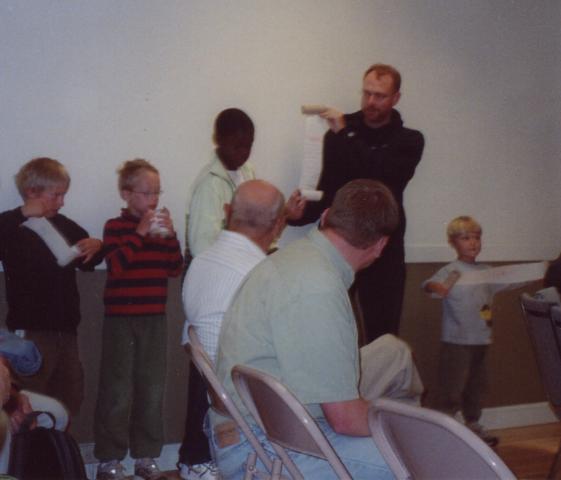
Scrolls redux - a photo

Children displaying their scrolls from Firstday School
The reportback from the scrolls lesson. Sorry to take so long, and for having such a grainy shot. We still use a film camera.

10/16/2006

What the Jesus People Do - San Francisco Edition

This past weekend Robin, the boys and I camped at Sierra Friends Center for College Park Quarterly Meeting's fall session. The ground was a bit hard, and we only had thin rollup mats under our sleeping bags. The hardest part was the cold on Friday night. On Saturday night, we got some blankets from a friend who had extra in the room she was staying in.

Lying awake on Friday night, I imagined how much harder concrete is, and how damp it is outside in San Francisco with only a blanket and no tent. How much harder it is to sleep at night. And how much harder it is to be homeless than just choosing to camp for two nights.

So today the San Francisco Chronicle ran this article about St. Boniface Church, the Franciscan parish in the Tenderloin District:
Church program for homeless cuts its hours

Robin used to work there. At a recent session looking at stewardship of the Meeting's resources, a Friend in our meeting confessed she sends more of her money to an unnamed Catholic church -- which I'm pretty sure is St. Boniface -- rather than our Meeting because the church "walks the walk."

See the photo essay with the Chronicle story, particularly. Some of the images are from about two years ago. The one that gets me is this one, because it looks like people lined up in coffins. If I weren't at work with three other people, I'd be weeping right now.

Maybe I need to remember to work harder every day to get affordable housing built. It's a long, slow, and challenging process to change opinions of elected leaders and voters. What else could I do to help, sooner? Am I too comfortable in my work environment? Lord, have mercy on me, a sinner.

- - -
Update (later 10/15/06): There was a story in the Seattle Times about the situation at University Friends Meeting here. Sounds like it was a challenging situation. San Francisco Monthly Meeting deals with similar issues. The Times had an interesting sidebar with "Quaker facts."

9/27/2006

About "On the Quaker Doctrine of the Holy Spirit": Plus ca change...

Spoiler alert: This is the explanation of my previous post. I recommend you read that post and comments before proceeding.

To summarize:

Friend 1 writes a post about his understanding of the Quaker view of the Holy Spirit. Friends 2, 3, and 4 respond in the comments with criticism, praise, explications, and nuances. Friend 1 replies and attempts to address, briefly, the points raised by the other three.

A Quaker blog comment thread, right?

Wrong! As Liz Opp guessed, it's from another source altogether.

- - - - -

Specifically, it's excerpted from Quaker Religious Thought, Volume 1, Number 1, from spring 1959. Friend 1 was Howard Brinton, author of Friends for 300 Years among many others; Friend 2 the late Lewis Benson (LSB), the founder of New Foundation Fellowship; Friend 3 was Thomas S. Brown (TSB), then the principal of Barnesville Friends School and still listed as an emeritus trustee of the Westtown Friends School (class of '29!); and Friend 4 was Charles F. Thomas, then pastor of Friends Meeting in Winchester, Ind. and who passed away a few years ago at 94.

What struck me was how similar the format was to a blog: Essay, three comments by others, then a response by the original author. And how similar in spirit the content is to some of the conversation in the Quaker blogosphere today.

Familiar names populate the masthead of the journal. Wilmer Cooper, Hugh Barbour, T. Canby Jones, Paul Lacey, and Arthur O. Roberts were all on the steering committee, as were Benson, Brown, and Thomas. The editorial committee included Benson, Brown, and Thomas, as well as Kenneth Boulding, Roberts, and Douglas Steere.

I hope Friends will indulge my experiment that was not quite in keeping with a single standard of blogging. The elevated style of writing was in itself a clue that this was not really a typical blog post.

Oh, and just for the record, Liz Opp and Gregg Koskela are both real bloggers leaving real comments! I know because I've met them both! :)